


Research Rooted in Community: Dr Elizabeth Ndakukamo’s Work Reimagines Cervical Cancer Prevention in Rural Namibia
For many women in rural Namibia, cervical cancer prevention is not only a medical issue. It is also a question of awareness, distance, trust, cultural understanding and access to services.
This is the reality that shaped the doctoral research of Dr Elizabeth K. Ndakukamo, a Lecturer at the Namibia University of Science and Technology, who graduated with a Doctor of Philosophy degree on Friday, 8 May 2026. Originally from Engela in the Ohangwena Region, Dr Ndakukamo’s academic journey has remained closely connected to the lived experiences of communities like the one she comes from.
Her thesis, titled “Community-Based Model for Cervical Cancer Prevention in Ohangwena and Kavango West Regions, Namibia,” focused on one of the most pressing women’s health challenges in the country. Cervical cancer is largely preventable through HPV vaccination, regular screening and early treatment, but it continues to affect many women, especially in low-resource settings where access to prevention services remains unequal.
Supervised by Prof Roswitha Mahalie, with Dr Pandu Hailonga-van Dijk as Co-Supervisor, Dr Ndakukamo’s study explored why prevention services are not always reaching the women who need them most. Using surveys, interviews and focus group discussions, she examined community knowledge, attitudes, health-seeking behaviour and health system constraints in the Ohangwena and Kavango West regions.
Her findings showed that although many women hold positive attitudes toward screening, several barriers continue to affect uptake. These include limited knowledge, fear of diagnosis, low male involvement, weak referral systems, shortages of supplies, staffing constraints and limited infrastructure. At the same time, the study found that existing community structures and growing awareness of women’s health rights offer important opportunities for change. From these findings, Dr Ndakukamo developed a community-based model that places people at the centre of prevention. The model calls for stronger health education, decentralised screening services, greater male involvement, better referral systems and improved support for frontline health workers.
For Dr Ndakukamo, the PhD was never only about obtaining a qualification. “This wasn’t just about getting a qualification, it was about contributing to something meaningful, something that could improve how cervical cancer prevention is approached in our communities.”
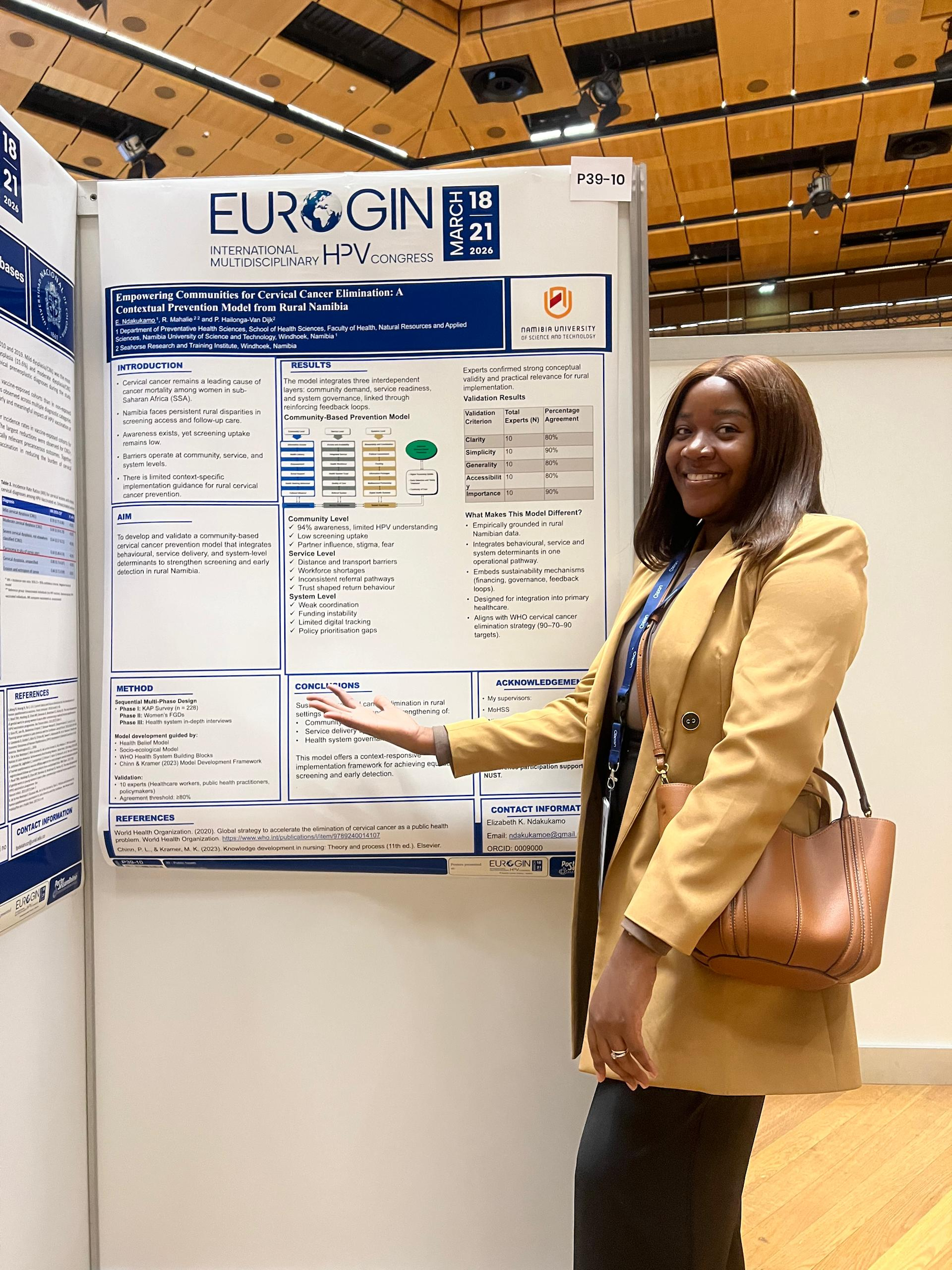
Her research has also travelled beyond Namibia. Dr Ndakukamo presented her work at the international multidisciplinary HPV congress in Vienna, Austria, where researchers, policymakers and public health practitioners gathered to discuss solutions to HPV-related diseases. Her participation demonstrated how research grounded in rural Namibian communities can contribute to global conversations on public health, prevention and equity.
Behind this academic milestone is also a deeply human story of perseverance. Dr Ndakukamo completed her PhD in three years while navigating pregnancy, early motherhood, fieldwork and academic responsibilities. She wrote during nap times, reviewed transcripts late at night and continued working through physically and emotionally demanding seasons.
Her journey reflects the kind of research impact that the Directorate of Research, Innovation and Partnerships (DRIP) continues to champion: science that begins with real community challenges, produces practical solutions and contributes to national development.
As Namibia continues to strengthen women’s health systems, Dr Ndakukamo’s work offers a timely reminder that prevention must be brought closer to the people. When communities are informed, health systems are responsive and research listens carefully to lived realities, science becomes more than knowledge. It becomes a pathway to saving lives.