

Sub-Saharan Africa Teacher Leadership for Education for Sustainable Development Project: NUST participates in international collaboration to strengthen teacher education
The Namibia University of Science and Technology (NUST) is part of an international consortium of African and European universities implementing a transformative project aimed at strengthening teacher leadership and advancing Education for Sustainable Development (ESD) across Sub-Saharan Africa.
“Predictions say that by 2050, half of the world's youth will live in Africa, making education a key driver of sustainable development,” says Prof. Dr. Daniel Fischer, Professor for Sustainability Education and Communication.
NUST is contributing to a major international collaboration under the project titled “Sub-Saharan Africa Teacher Leadership for Education for Sustainable Development.” The initiative brings together 15 partner institutions from Africa and Europe to address critical challenges in teacher education and to strengthen ESD across the region.
Leuphana University Lüneburg with Prof. Dr. Daniel Fischer as principal investigator and head of the project consortium, Deepika Joon and Dr. Claire Grauer as project coordinators, and universities in South Africa, Zambia, Namibia, Malawi, Kenya, Cyprus, and Greece.
Distinguished Prof Dr. Heila Lotz-Sisitka and Dr Charles Chikunda at Rhodes University in South Africa are leading the African regional coordination of the project. The project responds to pressing concerns such as teacher shortages and the need to enhance the quality and responsiveness of teacher education systems in Sub-Saharan Africa. It is grounded in the understanding that education will play a central role in advancing sustainable development on the African continent, particularly considering a rapidly growing youth population.The team of NUST is led by Dr Nico Sisinyize from the department of Technical and Vocational Education and views the university’s engagement as an excellent opportunity to integrate ESD into TVET. The other team members from NUST include Mr David Mateu, Dr Onesmus Aloovi and Dr Godfrey Tubaundule. The project commenced in November 2024 and NUST has been actively supporting the project implementation. During the initial phase, the team reached out to education stakeholders in Namibia on understanding to promote awarenes project among staff, departments, and relevant institutional bodies. This was followed by the administration of University Sustainability Assessment Tool (USAT) to understand how NUST integrates ESD into teacher education. This was followed by participation in an intensive “Train the Trainers” course where NUST team build its capacities on facilitating online course on ESD Teacher Leadership. The university also set up mini-ICT ESD lab to provide infrastructure for the training of 40 ESD leaders.
NUST joins partner institutions from South Africa, Zambia, Malawi, Kenya, Cyprus, and Greece in this collaborative effort and builds on over 30 years of research and practice in ESD and teacher education across African and European contexts.
The initiative aims to strengthen the leadership capacity of teacher educators and academic staff so that they can better prepare future generations with the knowledge, skills, and values required for sustainable development, inclusive societies, and participation in the green economy. A major focus is placed on enhancing teacher leadership to drive curriculum innovation and transformative pedagogical practices.
A central component of the project is the implementation of ESD Change Projects, an action-learning approach that empowers educators and students to initiate institutional transformation within their teaching and learning environments. Through this model, participants are encouraged to promote innovative teaching practices, strengthen learner agency, and support sustainable change in higher education institutions.
Aligned with the United Nations Sustainable Development Goals (SDGs) and the African Union Framework for Competences and Standards for the Teaching Profession (2023), the initiative contributes to strengthening policy and practice for embedding ESD in teacher education systems across Africa.
Our partner university from Namibia, the University of Namibia is leading the work package on capacity building. A significant milestone was achieved through a Training of Trainers programme led by Dr Sirkka Tshininganyamwe of the University of Namibia (UNAM) and Teresa Ruckelshaus of Heidelberg University of Education. The programme produced a cohort of 40 trained teacher educators across partner institutions, who are now equipped to facilitate ESD leadership training and support the implementation of ESD Change Projects.
Co-funded by the European Commission through the Erasmus+ programme and supported by African partner institutions, the project reflects a strong commitment to collaborative innovation and the transformation of teacher education for sustainable development across Sub-Saharan Africa.
More details about the project can be seen at https://lead4esd.net/
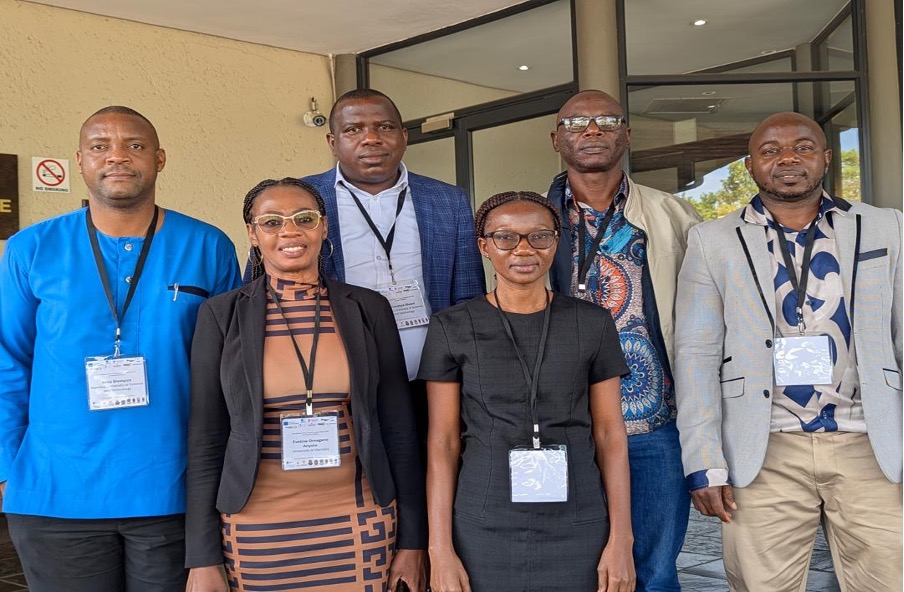
Photo: The team of Namibia University of Science and Technology with members from University of Namibia
Credit: Ulisha Van den Merwe