
Beyond the Ranking
… NUST’s impact is reaching communities
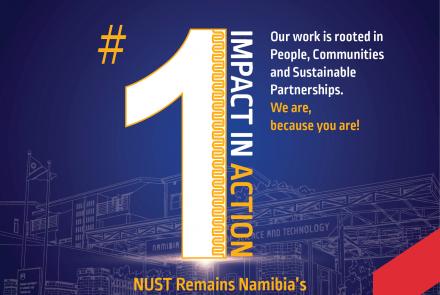
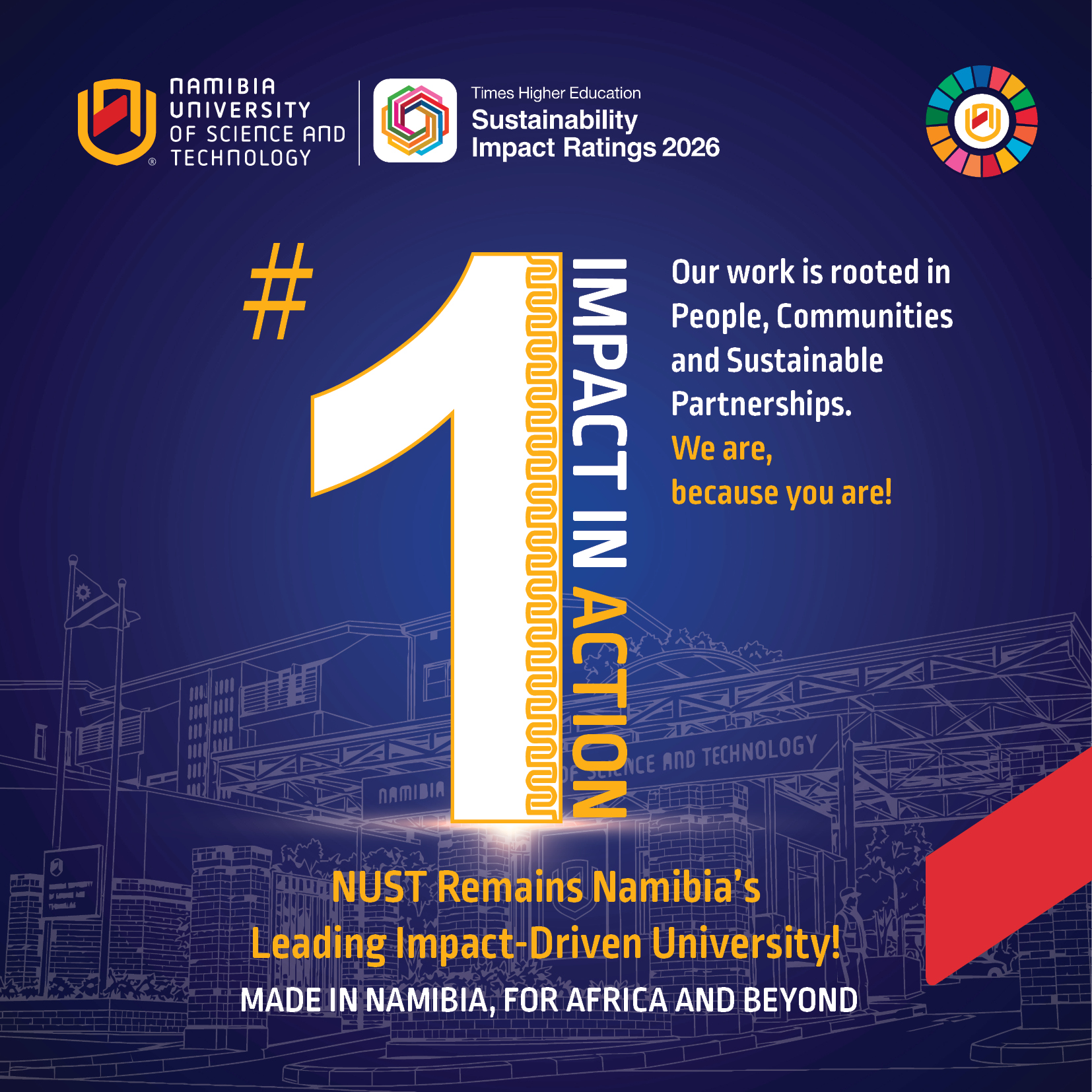
The latest Times Higher Education Impact Rankings tell an encouraging story about the Namibia University of Science and Technology (NUST). The University has retained its position as Namibia’s leading institution for impact and improved its overall global performance from the 1501+ band last year, to the 1001-1500 band in 2026. Yet the more important story lies behind the ranking: the practical ways in which NUST’s research, teaching, innovation and partnerships are changing lives, strengthening communities and contributing to national development.
NUST’s improved performance is strongly linked to its identity as a university of science and technology. Its impact is not built only on academic outputs, but on the ability to apply knowledge to real problems. This is visible in SDG 4: Quality Education, where NUST recorded its strongest improvement, moving from the 601-800 band to the 301-400 band. The University’s contribution to quality education is reflected in practical curricula, work-integrated learning, public lectures, regional reach, digital resources and lifelong learning. Through open educational resources, accessible library services, the Ounongo Repository, public lectures and short courses, NUST extends learning beyond enrolled students.
Stronger global performance. Stronger Local Impact.
That education mandate is visible in vocational and industry-responsive skills development. Through the Regional Upscaling Platform for Vocational Excellence, hosted with Stellenbosch University under ACEWATER III, NUST is helping to shape a more coordinated approach to water-sector skills in Namibia. The initiative connects academia, water utilities, renewable energy stakeholders and industry partners around the Water-Energy-Food nexus, while positioning NUST as a national coordinator in efforts to strengthen vocational excellence. This matters because the future of Namibia’s water, energy and food systems depends not only on research, but on technicians, trainers and graduates with the right applied skills.
NUST’s green hydrogen work provides another example of research translated into national opportunity. The IGNITE GH2 project, funded by the European Union through a EUR2 million investment and led by NUST’s Technical and Vocational Education and Training Department, responds directly to Namibia’s skills deficit in the emerging green hydrogen sector. The project brings together partners including Hyphen Hydrogen Energy, Zhero Molecules Walvis Bay, the Namibia Institute of Mining and Technology and NamWater. Its aim is to align training with employment opportunities by upskilling and reskilling 685 unemployed graduates and training 40 instructors.
Eradicating Poverty
The University’s contribution to poverty reduction is equally practical. NUST’s improvement in SDG 1: No Poverty reflects work that connects access, student support, entrepreneurship and community service. The Student Welfare Fund provides emergency assistance to students facing temporary hardship, supporting needs such as transport, meals, accommodation, medical referrals, toiletries and essential study spaces. These interventions matter because poverty can interrupt learning, delay completion and limit the life chances of students who are academically capable but financially vulnerable.
Entrepreneurship as a Pathway to Livelihood
Beyond the campus, NUST supports entrepreneurship as a pathway to livelihoods. Through business incubation, Inspire to Start-Up, business idea competitions, Boost-Up events and FabLab access, students and entrepreneurs receive training in ideation, market research, business modelling, pitch preparation and intellectual property awareness. These initiatives help move ideas from concept to prototype and, ultimately, to market-ready ventures.
One of the clearest community impact examples is the NUST-SEED Living Lab near Groot Aub in the !Kharoxas community. Established in collaboration with the Technical University of Munich through the Sustainable Energy and Entrepreneurship Development Centre, the Living Lab has delivered tangible services and enterprise opportunities. The community has benefited from a 20kWp solar photovoltaic plant, a solar-powered borehole water pump with storage, a poultry house and egg incubator, marula seedlings, a bush-feed crushing machine and a community garden. This demonstrates how applied research can become infrastructure, energy access, water access, food production and enterprise support.
Communities First
NUST’s health research also shows how impact begins with listening to communities. Dr Elizabeth Ndakukamo’s doctoral research developed a community-based model for cervical cancer prevention in Ohangwena and Kavango West. Her study examined knowledge, attitudes, health-seeking behaviour and health-system barriers, including fear of diagnosis, low male involvement, weak referral systems and shortages of supplies. The resulting model calls for stronger health education, decentralised screening, greater male involvement and better support for frontline health workers.
Food security is another area where NUST research is connected to Namibia’s future. Prof Percy Chimwamurombe’s participation in CIFAR’s Future of Food initiative places NUST in a global conversation on resilient food systems, indigenous foods and climate-smart crops such as marama, Bambara groundnut and cowpea. This work speaks directly to Namibia’s need for drought-tolerant, nutritious crops and stronger local value chains, while supporting national ambitions to improve food self-sufficiency and resilience in the face of climate change.
Water research further strengthens NUST’s regional impact. At the 26th WaterNet Symposium in Lusaka, NUST researchers and postgraduate students presented work from projects such as WaMiSAR, the SASSCAL Graduate Studies Programme in Integrated Water Resources Management, ACEWATER III and Innovate 4 Water. The research addressed ecosystem resilience, mining-affected water security, transboundary water governance, groundwater resilience, water-quality challenges and household water insecurity. These are daily development challenges across Southern Africa.
Collaboration Matters
NUST’s impact is also carried through partnerships. The Multidisciplinary Mobility for a Climate Resilient Africa project, an EU-funded 48-month consortium involving African universities and the University of Twente, aims to support 95 mobility opportunities for master’s students, doctoral candidates, trainees and staff. Through such initiatives, NUST contributes to building African research capacity for climate resilience.
Gender equality adds another important dimension. NUST’s entry into SDG 5 reflects work to support inclusive access, representation and opportunity. The University tracks gender-disaggregated applications and enrolment, supports postgraduate mentorship, promotes women in STEM, and implements social welfare programmes addressing gender-based challenges. Through the EntreprenHer digital literacy programme, more than 25 women micro-entrepreneurs in Khomas were trained to use digital tools, manage e-commerce platforms and improve customer engagement.
Taken together, these examples show why the ranking matters. NUST’s achievement is not only that it is ranked No. 1 in Namibia for impact. The deeper achievement is that its impact is visible in communities, classrooms, laboratories, public policy spaces, start-up ecosystems and international research networks. The ranking provides external validation, but the real story is the work itself: education that opens doors, research that responds to society, innovation that improves livelihoods and partnerships that help Namibia prepare for the future.