
Date: Thursday, 15 October 2026
Time: 17:00
Venue: Microsoft Teams
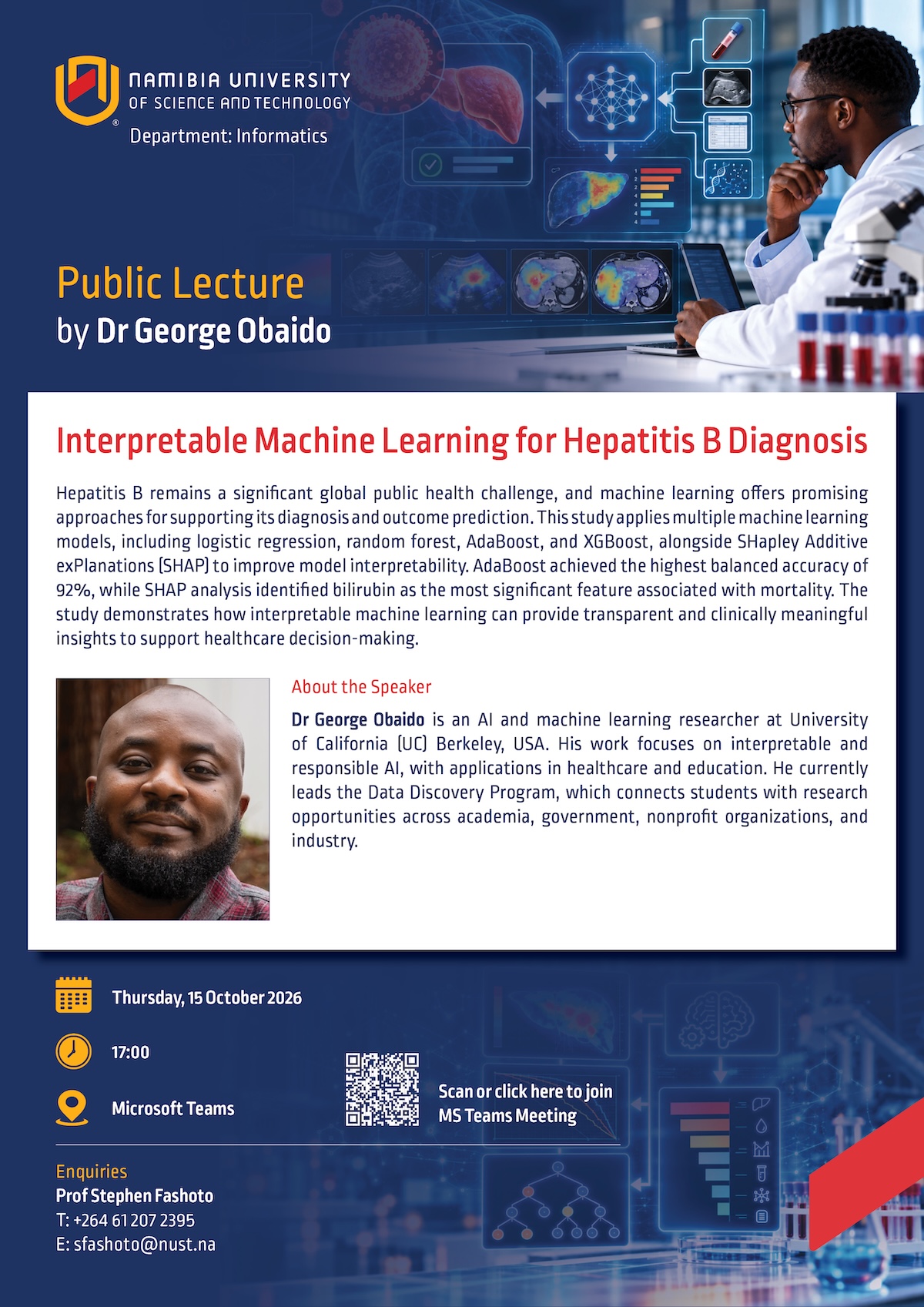
Hepatitis B remains a significant global public health challenge, and machine learning offers promising approaches for supporting its diagnosis and outcome prediction. This study applies multiple machine learning models, including logistic regression, random forest, AdaBoost, and XGBoost, alongside SHapley Additive exPlanations [SHAP) to improve model interpretability. AdaBoost achieved the highest balanced accuracy of 92%, while SHAP analysis identified bilirubin as the most significant feature associated with mortality. The study demonstrates how interpretable machine learning can provide transparent and clinically meaningful insights to support healthcare decision-making.
About the Speaker
Dr George Obaido is an Al and machine learning researcher at University of California [UC) Berkeley, USA. His work focuses on interpretable and responsible Al, with applications in healthcare and education. He currently leads the Data Discovery Program, which connects students with research opportunities across academia, government, nonprofit organizations, and industry.
| Attachment | Size |
|---|---|
| Interpretable Machine Learning for Hepatitis B Diagnosis1 (1).jpg (615.83 KB) | 615.83 KB |