
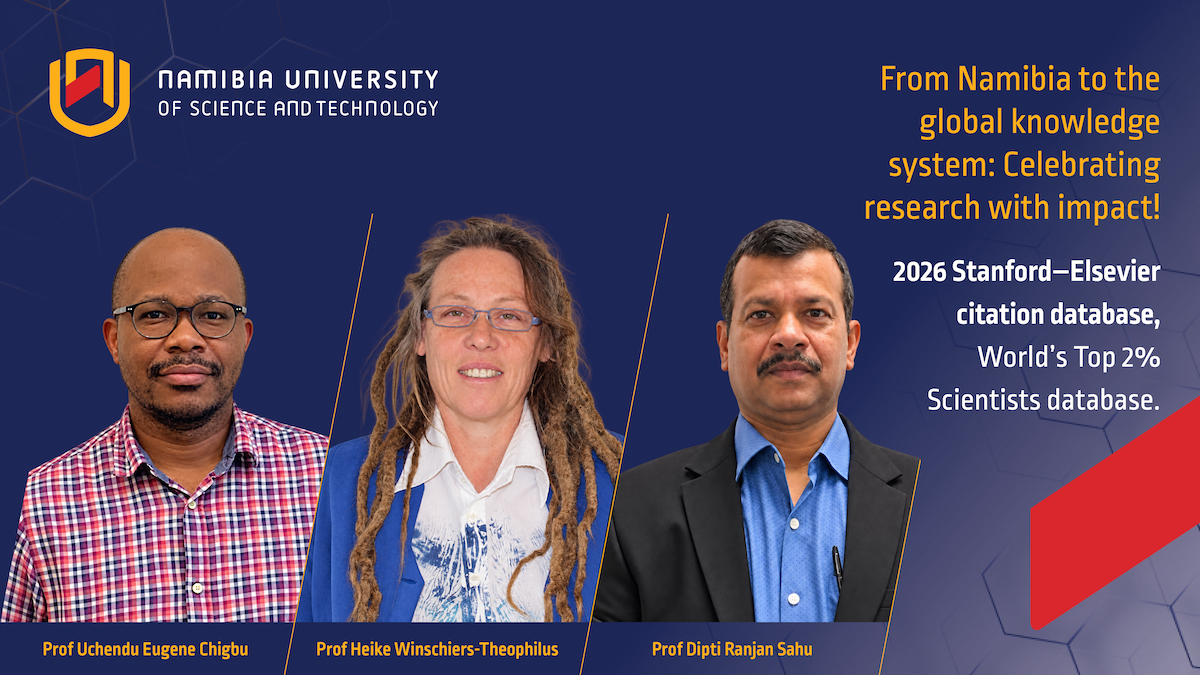
Namibian research recognised: celebrating contributions to Africa and beyond
Research from Namibia contributes to a global exchange of ideas, evidence and innovation. The inclusion of researchers from the Namibia University of Science and Technology (NUST) and the University of Namibia (UNAM) in the 2026 Stanford–Elsevier citation database offers an opportunity to celebrate the people helping advance this work.
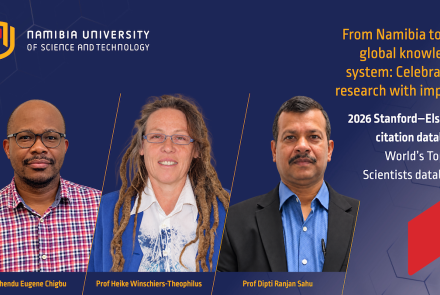
NUST, Professors Uchendu Eugene Chigbu, Heike Winschiers-Theophilus and Dipti Ranjan Sahu feature across the database’s single-year and career-long lists, widely known as the World’s Top 2% Scientists database. Their research spans land governance, inclusive digital technologies and advanced materials.
Prof. Chigbu’s work addresses land tenure, land-use planning and governance, connecting challenges facing Namibian and African communities with international discussions about inclusive development. In the single-year assessment of citations received during 2025, he places in the top 0.691% of Urban & Regional Planning, excluding self-citations.
Prof. Winschiers-Theophilus works with Indigenous communities to co-design technologies that reflect their knowledge, priorities and aspirations. Her research brings perspectives often excluded from technology development into the creation of digital tools and research methods. She places in the top 1.977% of Artificial Intelligence & Image Processing in the single-year assessment, excluding self-citations. She also appears in the career-long list, where her top-2% subfield position applies when self-citations are included.
Prof. Sahu’s contributions to applied physics, materials science and nanotechnology include research relevant to batteries, smart windows and hydrogen technologies. His career-long assessment places him in the top 1.564% of Applied Physics, excluding self-citations, highlighting sustained contributions to the scientific foundations of energy and electronic technologies.
These achievements form part of a wider national story. Congratulations also go to UNAM and the researchers recognised in the national announcement, whose contributions add to Namibia’s participation in international research.
The National Commission on Research, Science and Technology (NCRST) deserves acknowledgement for highlighting these achievements and promoting public appreciation of science, technology and research. Such visibility helps connect scientific work with the society it seeks to serve.
Citation indicators capture one dimension of research influence. The wider contribution also includes teaching, mentorship, community partnerships and knowledge that can inform decisions and future innovation. Students, collaborators and community knowledge holders are essential partners in this work.
Together, these contributions provide reason to celebrate research rooted in Namibia, responsive to African priorities and connected to questions that matter beyond the continent.
Source: Ioannidis (2026), science-wide author database of standardised citation indicators, Version 9.